GOSH YPAG and UCL Division of Psychiatry: Children and Young People’s Mental Health Module, UCL MSc in Mental Health Sciences: A Sustained Youth Involvement Model
By London YPAG,
Working together teaching postgraduate students how to carry out research with young people since February 2020! Read on to for a combined Blog from three of this year’s GOSH YPAG member attendees as they reflect on their annual visit in February 2026 to work with over 30 students
Thank you to Aleena Lu’Lu, Betty and Eva for contributing to this Blog and all the GOSH YPAG members who also attended on the day.
Over to Aleena Lu’Lu for her take on the day…..
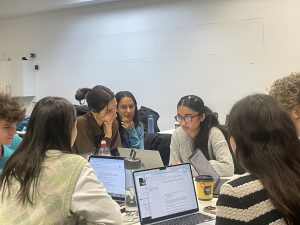
Working closely with two groups of students, I provided feedback on Consent Forms. I suggested tag lines to each paragraph of the Patient Information Sheet; two pages.
The Consent Form was well formatted as an easy-read document with a tick box on one page.
Master’s Degree students expressed there was a difference in working with adults for feedback than today’s experience with young people from GOSH YPAG – this group was working with young people for the first time.
Master’s Degree Psychiatry Student (group of four):
They discussed how social experiences affect young people’s moods. Their consent form was suitable for school visits, and they specified where it will be shared amongst young people.
What made this task more interesting was the way in which students explained their consent forms were designed for all pupils at secondary schools, without excluding any pupils – keeping research fair for all without excluding any students.
Grouped data would be drawn from all questionnaires returned from students.
‘Risks’ were commented on, as a sign of worry for a young person, as peers notice when a young person is seen to sign a consent form (bullying cases), especially if ‘risks’ are noted in paragraphs. We suggested a change to use other terms, but this needed further thought. It was decided that the terms ‘challenges and risks’, are to be reconsidered because the social status of peers is sensitive and young people discuss consent forms between themselves. Entering the term ‘risks’ may cause a young person to overthink a situation.
Takeaways and Watch this Space
I fedback how much I enjoyed reviewing work sheets felt GOSH YPAG members were made feel welcomed.
Our workshop session was enjoyable and interactive, with our voices being taken seriously.
Seeing forms taken to the next level for approval means that young patients are receiving information that targets their interests and is more relatable.
We met with PhD researchers, now studying a fellowship and specialising in health and wellbeing for young people.
Workshop Organisers shared their student careers with GOSH YPAG members over lunch.
I offered to support the UCL Division of Psychiatry at future events. I am also interested in knowing which patient information finally reaches schools, to which communities, and how information will be used to help services from today’s sharing of ideas.
Now over to Betty
Key Takeaways:
I think the key takeaway would be that I am not actually that far off being a university student like the students, and I felt like they made the experience look fun and appealing, so maybe university isn’t as daunting as it first appears.
I also felt like this workshop made me feel more confident in my own communication and analytical skills, which was nice.
It was very interesting to see all the different courses under the umbrella of psychiatry, and I also got an insight into what it is really like at university, which is useful since I am currently looking at my university options. As well as this, it was very interesting to see how small changes in wording of the information sheets could make a section much more understandable.
I felt like there were things that students missed which seemed relatively obvious to me, and in order to build them into people who can make information sheets like that for young people in future, they need to have an insight into the minds of the people that the materials are being designed for.
I think it would be important to say that this was a very useful experience for both parties, and I would strongly recommend other GOSH YPAG taking part in this next year!
Final reflective piece from Eva
On the experience
It was an incredible experience to meet the MSc students, see how they learn and think and what research they conduct in the department of Mental Health Sciences at UCL.
It was a wonderful way to see how research is conducted at master’s level and consult students about their lives doing a MSc, asking them how they reached that point. We saw the passion these students had for the subject they were studying and the research they were undertaking and it was an inspirational launching point for those of us who wanted to explore academics like they have one day in the future.
It was also a wonderful experience to meet fellow GOSH YPAG members face to face, have lunch together and here about their lives. Whether they were doing GCSEs, A-levels or cruising through secondary school- it was nice to see them in person rather than through their Zoom screen.
On meeting the students of MSc in Mental Health Sciences and giving them advice on how to craft suitable information sheets and consent forms for young people:
These documents were based on the title: How cognitive distortions and gender differences affect the development of adolescent depression.
Information Sheets:
The best information sheets used subheadings for each section (e.g. hy are we conducting this study, What will you have to do, Debriefing).
These made each piece of information distinct to participants.
In cases where there were large chunks of information, students highlighted key terms (like computer-based and anonymous) in bold.
Key information missed as a result of it being missing on the spec came down to the location and time of the study.
There was also no data on ‘payment’ for participation.
The language used was perfect to balance comprehension for the Year 7’s and avoiding patronisation with the Year 10’s.
The activities weren’t very well explained- slightly vague- however the idea of using examples to illustrate them brought to question validity and the cause of bias.
A common discussion that came up was the means to convey this information to participants: Who should explain it: a researcher or trusted guardian? (we left it as a decision for the participant).
One student recommended a power point- so questions could be asked and answered per slide and it would not seem like an overload of information- rather it would be familiar as this is how teachers often teach. This information could be reinforced with posters which solidify the information.
Consent forms:
The consent forms overall were very well structured.
Each bullet point check box ensured the key points explained in the information sheet were summarised and re-affirmed.
GOSH YPAG receive a thank you E voucher and Certificate of Attendance. Lunch and travel expenses are provided
A big thank you to GOSH YPAG member Teo who hosted @ GreatOrmondSt Twitter account, to give visitors the inside scoop of the day’s activites at this year’s NIHR GOSH BRC Family Fun Day for research on 26 October 2019. Teo is a dedicated YPAG member and has been involved in lots of other activities to represent […]
A short 5 minute animation produced by the European Communication on Research Awareness Needs (ECRAN) project, describing the stages involved in clinical trials
This exercise develops knowledge of different types of research and related terminology. The task requires young people to match a phrase with its definition.